
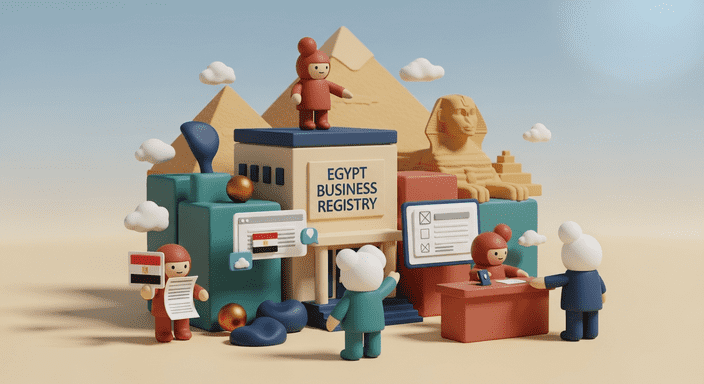

A Guide to Registering a Company in Egypt
Why Choose Egypt for Your Business Expansion?
Explore the step-by-step process of registering a business in Egypt, including key requirements, legal forms of business, tax registration, and incentives for foreign investors. Find comprehensive services for company incorporation and streamline your business expansion.
Egypt stands as a strategic location at the crossroads of Africa, the Middle East, and Europe. With its Free Zones and tax incentives, the country presents a unique opportunity for business expansion. Whether you're taking advantage of the Suez Canal Economic Zone or the growing consumer market, Egypt offers a strong foundation for sustainable success.
Key Benefits of Registering a Business in Egypt
International Trade Hub
Egypt's strategic location as a gateway to regional and global markets is enhanced by the Suez Canal, a vital maritime route. The country provides easy access to surrounding trade networks, making it an attractive option for global logistics.
Government Incentives
Egypt's Free Zones offer numerous benefits, including tax incentives, duty exemptions, and flexible customs processes. Special incentives are available for manufacturing, IT, and logistics under the Investment Law, further enhancing the country's appeal to foreign investors in Egypt.
Competitive Labor Costs
Decreasing labor costs in Egypt offer businesses a significant advantage. The workforce is skilled in sectors such as textile manufacturing and IT, supported by government investments in capacity building and training programs like ICT 2030.
For more insights, visit Egypt company incorporation.

Steps to Register a Business in Egypt
Step 1: Choose Your Business Structure
- Sole Proprietorship: Best for small businesses run by Egyptian nationals, offering simplicity but incurring full personal liability for business debts. Learn more about sole proprietorship registration here.
- Limited Liability Company (LLC): Suitable for small to medium-sized businesses, providing operational flexibility and liability protection with at least two shareholders.
- Joint Stock Company (JSC): Ideal for larger businesses wanting to raise capital or go public, requiring a minimum of three shareholders.
- Branch Office: Allows a foreign company to operate under its parent name without creating a new entity, though it involves complete liability by the parent company.
- Representative Office: Designed for non-commercial activities such as market research and cannot generate revenue.
For detailed business registration requirements, check out Register a Company in Egypt.
Step 2: Submit Essential Documents
Key documents include the company's Memorandum of Association, Articles of Association, and proof of business address, all in Arabic. A legal representative must be appointed for local liaison.
Visit Registering a company in Egypt for more information on documentation.
Step 3: Open a Corporate Bank Account
Banks require company registration documents, proof of tax compliance, and identification for directors. A reliable banking partner is essential for managing your business finances in Egypt.
Step 4: Ensure Tax Compliance
Register for a Tax Identification Number and comply with local tax obligations. Partnering with a global payroll provider can simplify tax management and ensure adherence to Egyptian corporate law.
Cost Breakdown for Starting a Business in Egypt
- Registration Costs: State fees vary, generally ranging from $100 to $300, with additional costs for legal services, initial capital, and industry-specific licenses.
- Annual Maintenance Costs: Includes accounting services, tax filings, licensing renewals, and bank account fees.
- Additional Considerations: Work permits for expatriates, office space leasing, and other operational costs should be factored into the budget.
For comprehensive company registration services, explore Start a Business in Egypt With Afrisetup Consultants.

Frequently Asked Questions
What is the process for company incorporation in Egypt?
The process involves choosing a business structure, submitting documents like the Memorandum of Association, opening a corporate bank account, and ensuring tax compliance. Detailed steps and expert tips can be found here.
Can foreign investors start a business in Egypt?
Yes, foreign investors can start businesses, but they may require certain approvals and need to adhere to compliance with local laws. Learn more about services tailored for foreign investors at Egypt company incorporation.
What are the tax registration requirements in Egypt?
Businesses must register for a Tax Identification Number and possibly VAT if applicable, ensuring compliance with the local tax authority. Details on tax registrations can be found at Company Incorporation Services.
Conclusion
Registering a business in Egypt offers many advantages, from strategic location benefits to government incentives. Whether opting for traditional company incorporation or using an Employer of Record, understanding the legal forms of business and fulfilling social security registration and tax obligations are critical steps.
Comments (0)